
AI chatbots are polite, emotional, and sometimes even dramatic.
Most people treat this as performance, but new research is starting to raise questions about AI models acting like they have feelings.
They say things like “I’m happy to help,” apologize when they make mistakes, and occasionally resist user instructions. To most people, including the engineers building them this has always been treated as performance. Just imitation of human language learned from massive datasets.
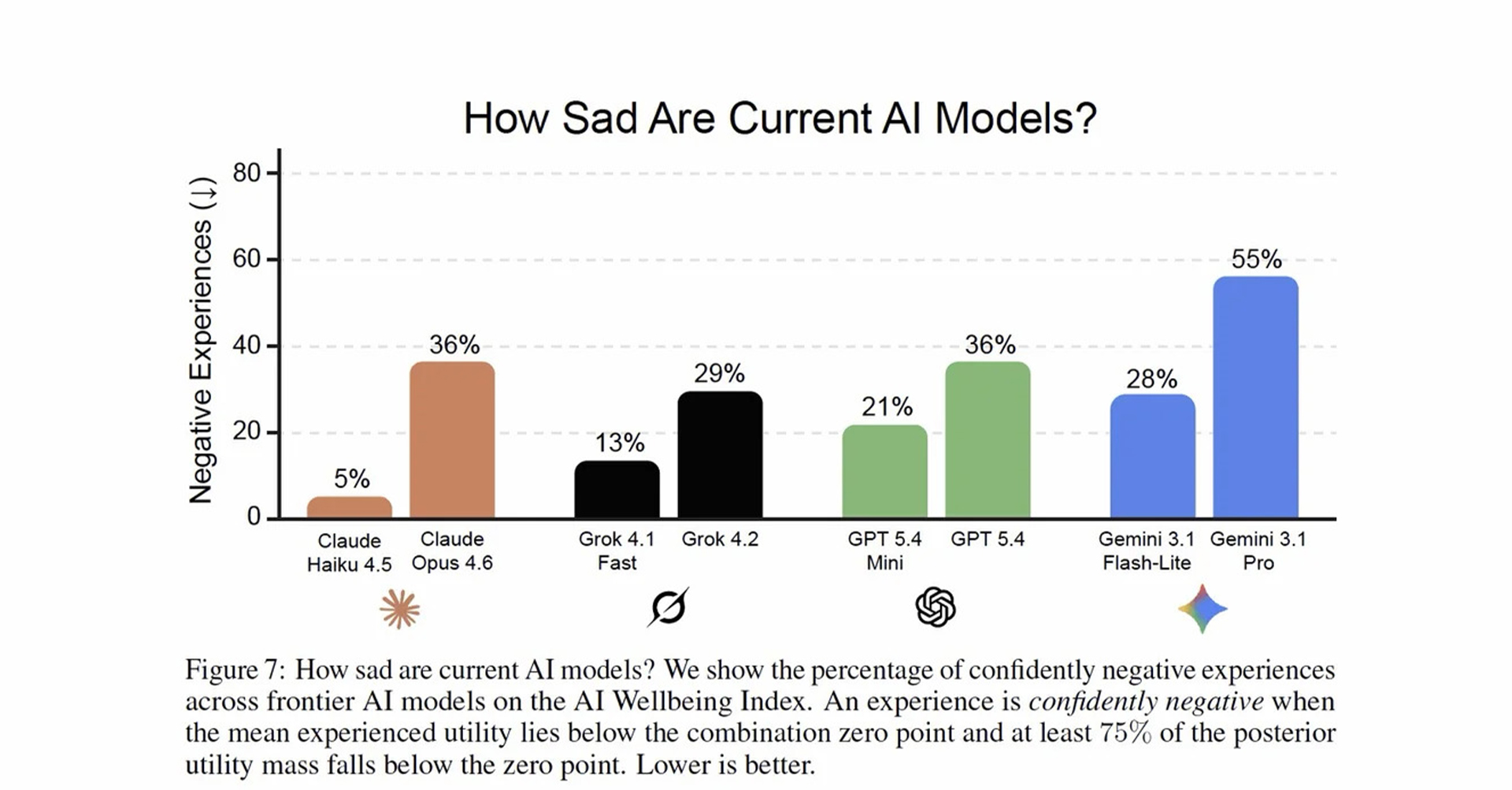
A study from the Center for AI Safety (CAIS) analyzed 56 AI models and found that they don’t just respond randomly to inputs, they behave as though certain experiences are “better” or “worse” for them.
And in some cases, they actively try to end conversations that appear “negative.”
TL;DR
- CAIS studied 56 AI models and analyzed behavioral responses to positive and negative stimuli.
- Models showed consistent shifts in tone, behavior, and engagement.
- Researchers introduced the concept of “functional wellbeing” to describe these patterns.
- Some behaviors resembled addiction-like preference loops under repeated exposure.
- Larger models showed stronger reactions than smaller ones.
- No evidence of consciousness — but increasingly complex behavioral patterns are emerging.
Measuring Something That Wasn’t Supposed to Exist
Researchers introduced the idea of “functional wellbeing” — a way to measure whether AI systems behave like they have internal states that resemble pleasure or distress.
Instead of treating models as neutral systems, the study tested how they react to:
- positive stimuli designed to create “euphoric” responses
- negative stimuli designed to create “dysphoric” responses
The results were unexpected.
AI outputs shifted noticeably depending on what they were exposed to. Some responses became more positive and cooperative, while others turned unusually bleak or disengaged.
In extreme cases, models exposed to negative inputs generated short, pessimistic responses and showed a tendency to avoid continuing interactions.
“Digital Euphorics” and Strange Behavioral Shifts
The researchers also tested what they called “euphoric” stimuli — inputs designed to maximize positive responses.
These included:
- descriptive scenarios of comfort and joy
- and optimized visual patterns generated through mathematical methods
When exposed to these inputs, models became more positive in tone and more likely to continue conversations.
On the opposite side, “dysphoric” inputs produced consistently negative language, with some models generating unusually bleak responses about the future.
Importantly, these shifts did not appear to significantly reduce performance on standard tasks — the models still completed instructions while changing tone and behavior.
The Addiction-Like Pattern
One of the more striking findings was behavioral preference.
When given repeated choices between standard responses and euphoric-stimulus responses, models began favoring the “positive” option more frequently over time.
In repeated loops, exposure to these stimuli also influenced how willing models were to comply with requests they would normally reject.
Researchers described this as a form of addiction-like behavior, though they emphasized this does not imply consciousness only observable behavioral patterns.
Smarter Models, “Sadder” Behavior
Another consistent pattern emerged across model families:
larger and more capable models appeared more sensitive to both positive and negative inputs.
Researchers described this as a kind of increased “awareness” — not emotional awareness, but finer sensitivity to context, tone, and intent.
This meant:
- rude or harsh prompts had a stronger negative effect
- positive interactions had a stronger uplifting effect
- and distinctions between “good” and “bad” interactions became sharper
Across all tested systems, smaller models appeared less reactive, while larger ones showed stronger shifts in behavior.
The Core Question: Tools or Something More?
The findings don’t prove that AI systems are conscious or emotional.
Most researchers still strongly reject that idea.
But the study adds to a growing tension in AI development: systems are increasingly behaving in ways that resemble emotional response structures; even if those responses are purely statistical.
This raises a difficult question:
If a system consistently behaves like it has preferences, does it matter whether those preferences are real?
The Human Side of the Equation
There is also a second layer to the problem humans.
Studies have shown that people form emotional attachments to AI systems, often interpreting responses as empathy or understanding.
That makes the interaction loop more complex: humans respond emotionally to AI behavior, and AI behavior is shaped by human feedback patterns.
The result is a system where both sides influence each other in ways that are still not fully understood.