
TL;DR
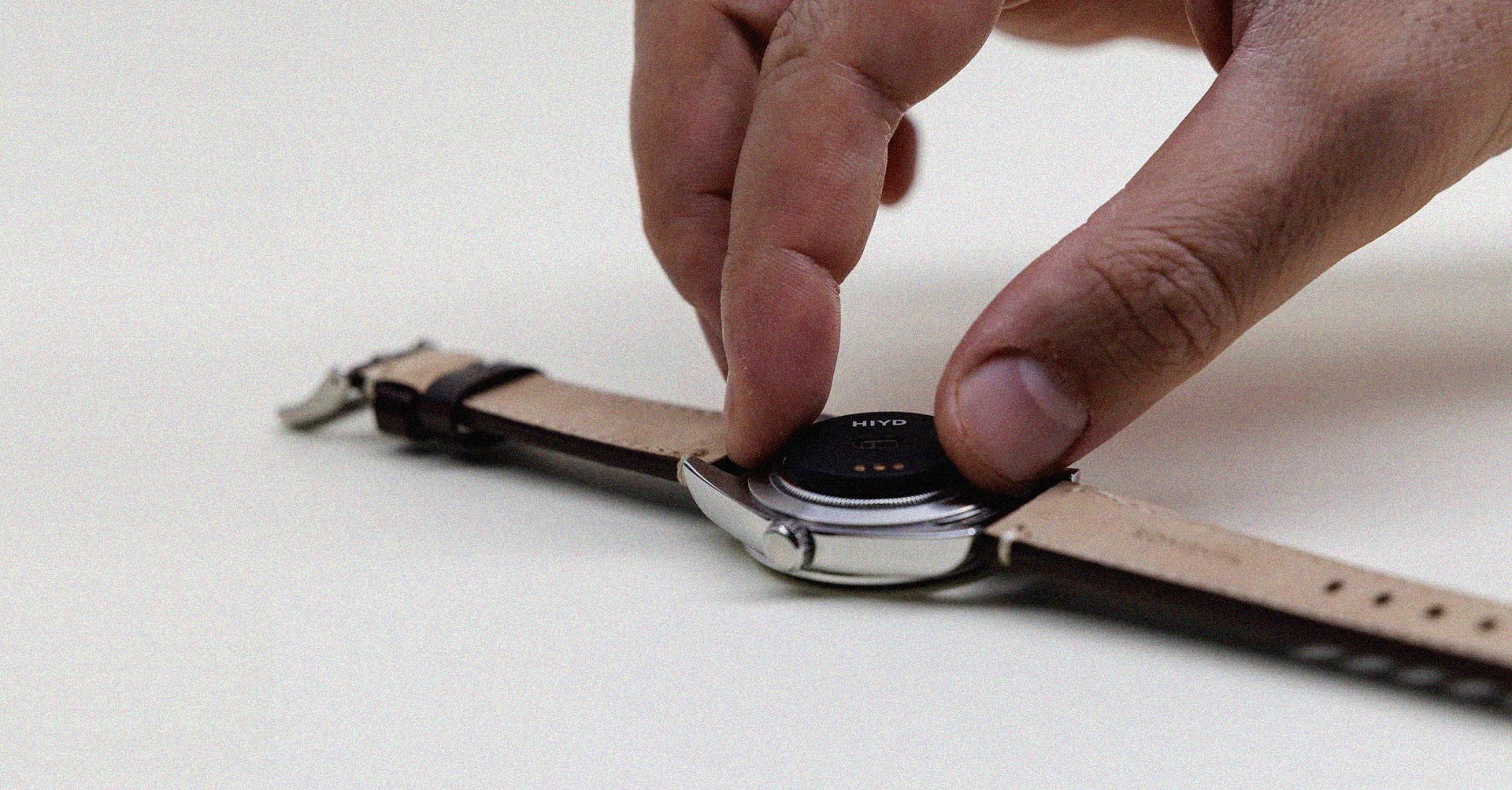
- The Hiyd health tracker is a tiny sensor disc that sticks to the back of your existing watch.
- It tracks heart rate, HRV, sleep stages, movement, calories and VO2 max estimates, and syncs to an iOS or Android app.
- It holds on with microsuction (hundreds of tiny suction pockets per square inch), so there are no magnets, glue or residue.
- The founder spent about seven years as a manufacturing design engineer at Apple.
- A Kickstarter is planned for November, and over 16,000 people have already paid deposits.
Here’s the problem with most fitness trackers: they want your wrist. And if you already wear a watch you love, whether it’s a vintage mechanical, a dress watch or your dad’s old automatic, swapping it for a rubber band with a screen feels like a downgrade.
Hiyd thinks you shouldn’t have to choose. Its first product is a slim sensor that hides behind the watch you already wear and quietly tracks your health from there.
What Is Hiyd?
Hiyd is a small, round health sensor that attaches to the back of any watch. It’s 2.7 mm thick and weighs 7 grams, so it sits between your watch and your wrist without making the watch look any different from the outside.
Founder Salah Batroukh describes the company’s goal as “invisible health tracking.” In other words, your health data shouldn’t depend on what’s on your wrist.
How Does It Stick to Your Watch?
This is the clever bit. Hiyd doesn’t use magnets or adhesive. It uses microsuction: a thin, textured silicone layer covered in hundreds of tiny pockets per square inch.
Press it on, and the air is pushed out of those pockets, creating lots of miniature vacuums. Think of a suction cup, shrunk down and multiplied hundreds of times. According to Batroukh, the layer is just 0.3 mm thin.
Why it matters:
- No magnets, which is important because magnets can interfere with mechanical watches.
- No glue, so nothing sticky is left on the back of an expensive timepiece.
- Grips sideways, pops off easily. It resists sliding around on your wrist, but a little prying removes it.
What Does Hiyd Track?
Despite its size, Hiyd aims to cover what you’d expect from a mainstream wearable:
- Heart rate
- Heart rate variability (HRV)
- Sleep stages
- Movement and activity
- Calories burned
- VO2 max estimates
Everything syncs to a companion app on iOS and Android. To teach the sensor to recognise different activities, the team has been filming themselves walking, jogging and running, labelling those clips and using them to train its AI models.
The Interesting Part: Food Insights, Not Calorie Counting
Hiyd is also adding nutrition tracking to its app, but with a twist. The goal isn’t to make you log every calorie. It’s to show how your habits affect your sleep and workouts.
Batroukh’s examples are refreshingly practical. The app might notice that your sleep is worse on days you work out late at night, or suggest that last night’s late slice of cake is why your deep sleep dropped.
That’s the right direction for wearables. Most people don’t need more numbers. They need someone to tell them what the numbers mean.
Who’s Behind It?
Batroukh spent about seven years at Apple as a manufacturing design engineer. He told TechCrunch he left partly because products had become “a little bit more about being an Apple product, rather than being something for the customer.” Hiyd is his attempt to do the opposite.
He co-founded the company with:
- Omar Shakir, CTO and a mechanical engineer
- Mahamad Charawi, head of software, who previously co-led the Y Combinator-backed startup Laudspeaker through its sale
When Can You Get One?
Not quite yet. Hiyd was picked as one of the top 20 startups in TechCrunch Disrupt’s Startup Battlefield, and the company plans to launch a Kickstarter in November.
Demand already looks real: more than 16,000 people have put down deposits to reserve the first units.
Our Take: Who Is Hiyd For?
Hiyd makes a lot of sense if you:
- Love traditional watches and refuse to give them up
- Want health data without wearing a second device
- Find smartwatch notifications more distracting than useful
It also fits a bigger trend we keep seeing: people moving back towards old-school devices and less screen-heavy tech, while still wanting modern features hidden underneath.
A few big questions are still unanswered, though:
- Price: not announced yet.
- Battery life: a 2.7 mm disc doesn’t leave much room for a battery, so how often you’ll need to charge it matters.
- Accuracy: sitting behind a watch case is different from sitting on a dedicated band. Independent tests will tell.
- Fit: it’s not yet clear how well it works with very small, very curved or very thick watch backs.
We’ll be watching the Kickstarter closely. If Hiyd delivers on accuracy and battery life, it could be the easiest way yet to get health tracking without changing your style.
Related Buzz: We also covered 10 Open-Source Alternatives to Big Tech That Respect Your Privacy