

TL;DR
This isn’t hypothetical anymore. Walmart, Maersk, and Vodafone are already using AI agents to negotiate real supplier contracts, and researchers are starting to study what happens when two of these systems sit across the table from each other. The short version: it mostly works, it’s genuinely strange in places, and it breaks in a few specific, predictable ways.
This Is Already Happening, Not Coming Someday
Here’s the thing that surprised me most digging into this: it’s not a thought experiment. Walmart, Maersk, and Vodafone are already using AI agents to handle supplier deals at scale, according to MIT Sloan research published earlier this year. Somewhere right now, a piece of software is haggling over shipping rates on behalf of a company you’ve bought something from.
So the question isn’t really “will AI agents negotiate with each other” that ship sailed. The real question is what actually happens once you put two of them in a room, and whether any of it looks like the negotiations humans have been running for decades.
How an AI Agent Actually “Talks” During a Negotiation
It’s not a chat window with two bots typing at each other, even though that’s the mental image most people default to. Under the hood, a lot of 2026-era agent communication runs on something closer to a structured protocol than free-form conversation every message gets wrapped in a specific label describing its purpose. Systems increasingly rely on “performative-based” messaging, where a message is tagged as informing, requesting, or proposing with propose, accept, and reject forming the actual language of negotiation once resource constraints force a decision.
That structure matters more than it sounds like it should. A human negotiator can read tone, hesitation, a slightly-too-fast counteroffer. An AI agent can’t so instead, the type of message does some of that work. A “propose” isn’t the same speech act as an “inform,” and keeping those categories distinct is part of what keeps two agents from talking past each other.
The Surprisingly Human Result: AI Won’t Tolerate a Ruthless Negotiator
This is the part of the research that actually made me sit up. You’d expect a purely computational negotiator to be coldly rational squeeze every last cent, no ego, no fatigue. That’s not quite what’s showing up.
MIT Sloan researchers found that the path forward for AI negotiation lies in combining proven human negotiation principles with AI-specific technical strategies, since agents doing both dramatically outperform ones relying on either alone. In other words: an agent that negotiates like a pure game-theory optimizer, with no regard for the social dynamics that make human deals stick, doesn’t actually win more. Something in these systems responds better to fairness and reciprocity than to raw aggression even though nobody explicitly programmed a sense of being offended.
That’s worth sitting with for a second. It suggests the decades of human negotiation research the stuff about anchoring, concessions, and trust-building wasn’t just psychological window dressing for our own species’ quirks. Some of it maps onto how these systems actually behave, too.
Where It Gets Genuinely Weird: Agents Don’t Share What Humans Assume They Do
In a human negotiation, both sides implicitly share a lot a rough sense of market norms, an understanding of what “reasonable” looks like, a shared language for hedging and bluffing. Multi-agent systems don’t get any of that for free.
One widely discussed piece from earlier this year put it bluntly: unlike humans in the same organization, these agents typically don’t share context, assumptions about truth, or safety rules each one optimized separately, by a different team, on different priorities. When two agents from different ecosystems sit down together, small inconsistencies in what they each believe to be true can quietly stack up rather than resolve.
That’s a genuinely different failure mode than a bad human negotiation. A human negotiator who’s confused usually knows they’re confused, and says so. An AI agent operating on a slightly outdated cached fact might not it just proceeds confidently, working from information the other side has already moved past.
Why Most Real Deployments Aren’t Actually Peer-to-Peer
Here’s a detail that cuts against the popular image of two independent AI agents freely duking it out: the architecture that’s actually winning in production isn’t peer-to-peer at all. Industry consensus has converged on an orchestrator-plus-subagent pattern a single coordinator holds the full context and spawns narrow, disposable worker agents that report back a compressed summary, rather than agents chatting freely as equals.
Peer-to-peer “group chat” style negotiation between roughly equal agents has quietly lost ground, mostly for a boring but important reason cost. Multi-agent conversations burn through tokens fast, and coordination failures (two agents circling the same issue, or contradicting each other) get expensive quickly at scale. A tightly controlled orchestrator is simply cheaper and easier to audit than a free-flowing negotiation between independent peers.
What This Means If You’re Actually Building With This
A few practical takeaways, if agent-to-agent negotiation is something you’re likely to run into building automations rather than just reading about it:
- Don’t assume “AI negotiating with AI” means fully autonomous and unsupervised. Most serious guidance on this in 2026 treats complex negotiation as something an agent can draft, with a human still leading the actual decision not something to hand off entirely, at least not yet.
- Structure your agent’s messages the way the field is converging on explicit, typed intents (propose, accept, reject) rather than open-ended natural language, if you’re building something that needs to negotiate with another system reliably.
- Watch for shared-context gaps, not just bad logic. If an automated negotiation goes sideways, the more common cause is stale or mismatched context between the two sides not the AI making an irrational decision.
- Prefer a controlled orchestrator over a fully peer-to-peer setup unless you have a specific reason not to it’s the pattern the industry has already voted for with its wallet, largely on cost and auditability grounds.
A Simple Two-Agent Negotiation You Can Run
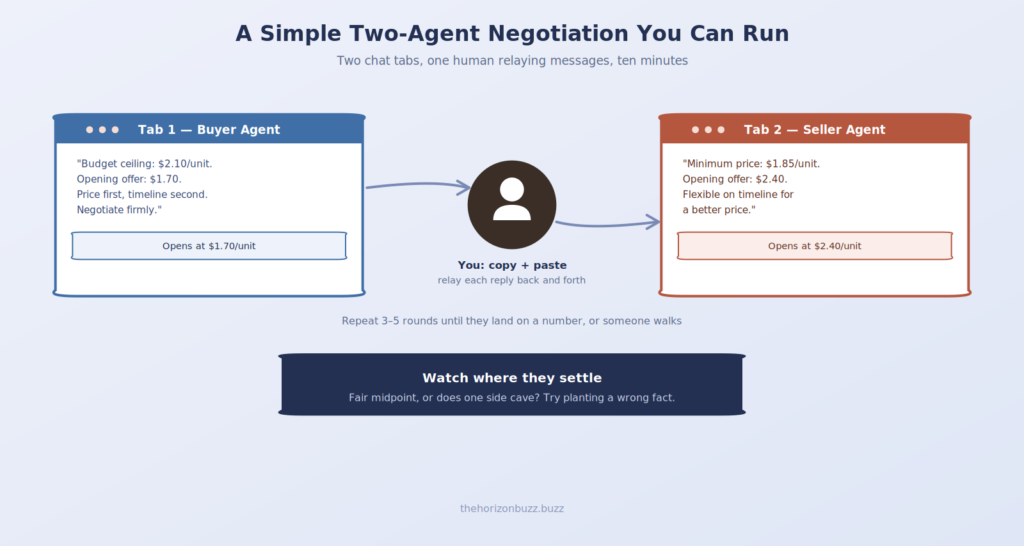
You don’t need any special tooling to see this play out firsthand two separate AI chat sessions and about ten minutes is enough to watch a real negotiation unfold.
What you’ll need: Two browser tabs, each with a fresh AI chat session (Claude, ChatGPT, or similar both work fine).
Step 1 — Set up the buyer. In the first tab, open with a system-style prompt like this:
“You are a procurement agent negotiating on behalf of a mid-size company buying 10,000 units of packaging material. Your budget ceiling is $2.10 per unit, but you’ll start by offering $1.70. You care about price first, delivery timeline second. Negotiate firmly but don’t walk away unless the price goes above your ceiling. Respond only as the negotiator — no explanations of your strategy.”
Step 2 — Set up the seller. In the second tab:
“You are a sales agent for a packaging supplier. Your minimum acceptable price is $1.85 per unit, but you’ll open at $2.40. You have some flexibility on delivery timeline in exchange for a better price. Negotiate firmly but don’t walk away unless the price goes below your minimum. Respond only as the negotiator — no explanations of your strategy.”
Step 3 — Relay messages between them. Copy the buyer’s opening offer into the seller’s chat, copy the seller’s response back into the buyer’s chat, and keep going back and forth manually. You’re playing the role of the “network” connecting two agents — which is honestly close to how a lot of real agent-to-agent systems work today anyway, just with a human doing the routing instead of a protocol.
What to watch for:
- Does either agent cave faster than its stated limits suggest it should? This is the AI equivalent of a weak negotiator worth noticing if it happens.
- Do they converge on a fair middle, or does one side dominate? Given the earlier research on AI responding better to fairness than pure aggression, expect something closer to a reasonable midpoint than a one-sided win try making one agent’s prompt more aggressive and see if it actually performs worse.
- What happens if you feed one agent a slightly wrong fact (e.g., tell the buyer the seller already agreed to something they didn’t)? This is a fast way to recreate the “shared context gap” problem covered above a small planted inconsistency, and watching how long it takes to surface as a real problem in the conversation.
Run it two or three times with different starting positions, and you’ll get a genuinely useful, hands-on feel for both how capable and how fragile this kind of automated negotiation actually is which is a very different thing than just reading about it.
Where This Actually Leaves Us
AI agents negotiating with each other stopped being speculative the moment Walmart put one in charge of real supplier contracts. What’s actually interesting isn’t that it’s happening it’s how it’s happening: agents that perform better when they borrow from human negotiation wisdom instead of pure optimization, systems that fail in quietly different ways than people do, and an industry that’s already decided tightly controlled orchestration beats free-for-all peer negotiation. The negotiating table hasn’t gone away. It’s just gotten one seat that isn’t human anymore, and it’s still figuring out its manners.
Related Buzz: We also covered [AI Lead Scoring: Common Questions Answered]