

TL;DR
Every “best tools for indie hackers” list on the internet has 15-50 entries on it, which is exactly the opposite of what actually works. The builders shipping real, paying products right now have converged on a much smaller pattern: one AI-assisted build tool, one hosted backend, and one payments tool that handles the boring parts. Everything else is optional until you have revenue.
The Stack at a Glance
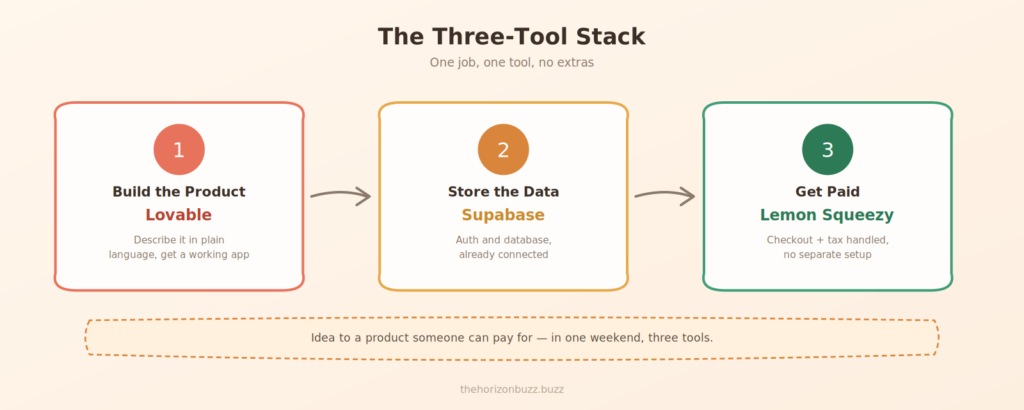
- Build the product → Lovable (free tier with limited credits) — if it’s not the right fit, try Bolt.new, v0, or Bubble
- Store the data → Supabase (generous free tier) — if it’s not the right fit, try Firebase or Airtable
- Get paid → Lemon Squeezy (free until you sell) — if it’s not the right fit, try Stripe or Paddle
What This Actually Looks Like Over a Weekend
It’s easier to see why this stack works when you walk through how the three tools connect, rather than looking at them as three separate decisions.
Friday evening: You describe the product to Lovable in plain language — say, a simple habit tracker with user accounts and a daily streak counter. Within the first session, you have a working frontend, and Lovable has already provisioned a Supabase project behind it for auth and data storage. You’re not setting up a database from scratch; it’s already connected.
Saturday: You spend the day actually using the product yourself, finding the rough edges, and asking Lovable to fix specific things — the streak counter resets wrong, the login page needs a password reset flow. Because Supabase is handling the real backend, none of these fixes require touching raw SQL. You check the Supabase dashboard once or twice just to confirm user signups are actually landing where they should.
Sunday: The product works well enough to show people. You connect Lemon Squeezy, set a single $5/month price, and get a checkout link no separate tax registration, no VAT number chasing, because Lemon Squeezy is the merchant of record on the sale. You post it somewhere small (a subreddit, a Discord, a few DMs to people who might actually want it) and get your first handful of signups by Sunday night.
That’s the entire loop: idea to a product someone can pay for, across one weekend, using exactly three tools. Nothing about this requires it to work perfectly the point is getting to a real answer (does anyone want this?) fast enough that a wrong answer only costs you a weekend, not a month.
Why the 50-Tool Lists Are Wrong
Open any “tools for indie hackers” roundup and you’ll find analytics dashboards, five different email tools, a project management app, a design tool, three separate AI coding assistants, and a CRM for a product that doesn’t have a single user yet. That’s not a stack, it’s a wishlist, and it’s exactly the kind of overhead that keeps a solo builder busy configuring things instead of shipping.
The actual pattern among people getting to a real, paying product looks a lot leaner. Pull the noise out and what’s left is three jobs that genuinely have to get done, and one tool doing each of them well.
Job 1: Turning an Idea Into a Working Product
This is the part that used to take weeks and now takes a weekend, and it’s the single biggest shift in what “solo builder” means in 2026. The tool doing this job needs to take a plain-language description and generate an actual working app frontend, backend, and database wired together not just a mockup.
The tool: Lovable
Lovable has become close to the default here. You describe the product, it generates a working React frontend with the backend already connected, and you’re showing something real to users within hours instead of weeks. What makes it different from a design tool is that the output is a real, running product, not a prototype you then have to rebuild from scratch to launch.
The honest caveat: this isn’t magic for genuinely complex logic. Tools in this category are strongest for getting from zero to a testable, demoable product fast the kind of thing you show ten people and watch their reaction to, not necessarily the final architecture you’ll run at scale. That’s fine. The job here isn’t “build the perfect system,” it’s “get something real in front of people before you’ve spent a month on it.”
If Lovable isn’t the right fit: Bolt.new is the closer competitor for full-stack prototypes built directly in the browser, and v0 is worth knowing about specifically for generating React/Next.js UI components when you already have a rough idea of what a screen should look like. Bubble remains the most capable option for genuinely complex internal logic (approval workflows, multi-step conditional forms) that the newer AI-first tools still struggle with it’s older and has a steeper learning curve, but it hasn’t been fully replaced.
Job 2: Somewhere for the Data to Actually Live
Once the product does something real — accounts, saved data, anything a user expects to persist — you need a backend that isn’t held together by hope. This is the job most solo builders used to either avoid (skip auth, skip a real database, hardcode everything) or massively over-engineer (spin up a full custom server before they had a single user).
The tool: Supabase
Supabase has become the default backend specifically because the AI build tools in Job 1 integrate with it natively you’re not stitching two separate systems together, the build tool already knows how to talk to it. It handles authentication and data storage without requiring you to write SQL by hand, and the dashboard is clean enough that a non-technical builder can actually see and understand what’s stored, not just trust that it’s happening somewhere.
The real value here isn’t the technical specs it’s that this job stopped being a decision. A few years ago, picking a backend meant genuinely comparing five platforms. Now it’s close to a default setting, which frees up the actual decision-making energy for the product itself.
If Supabase isn’t the right fit: Firebase is the longer-standing alternative and still worth it if you’re already inside the Google ecosystem or need its specific real-time sync behavior. For simple structured data without needing full backend infrastructure, Airtable functions as a lightweight database substitute that non-technical builders find easier to look at directly, though it won’t scale the same way once you have real production traffic.
Job 3: Actually Getting Paid
This is the job that gets skipped the longest, usually because it feels premature “I’ll add payments once I have users.” The problem is that adding it late means retrofitting a business model onto a product that wasn’t built to charge money, which is a much bigger job than building it in from day one.
The tool: Lemon Squeezy
Lemon Squeezy has become the community default for a specific reason it acts as merchant of record, meaning it handles global sales tax and VAT compliance for you. That sounds like a minor detail until you’re the one who has to figure out tax obligations across a dozen countries by yourself, which is precisely the kind of overhead a solo builder shouldn’t be spending time on. It’s the difference between “I want to charge money” and “I am charging money” being a single afternoon of setup instead of a legal research project.
If Lemon Squeezy isn’t the right fit: Stripe remains the standard if you want maximum control and are comfortable handling tax compliance yourself or through a separate service — it has a steeper setup but is more flexible for unusual pricing models. Paddle is the closer direct competitor to Lemon Squeezy, also operating as a merchant of record, and worth comparing directly if global tax handling is your main requirement.
What’s Deliberately Missing From This List
No analytics platform, no CRM, no project management tool, no dedicated email marketing suite. Not because those things are never useful because none of them are load-bearing before you have a product people are actually using and paying for. Every one of them can be added later, cheaply, once you know what you’re actually optimizing for. Adding them earlier just means configuring tools for a business that doesn’t exist yet.
The pattern worth noticing: 80% of indie hackers take over a month to ship their first version, and the bottleneck usually isn’t the coding it’s picking too many tools and over-engineering before there’s a single real user to build for. The three-tool stack isn’t a compromise. It’s the fastest path to finding out if the thing you’re building actually matters, which is the only question worth answering before you spend more time on anything else.
FAQ
- What tools do most indie hackers actually use in 2026?
The pattern that shows up most consistently across builder communities is an AI-assisted build tool (like Lovable) paired with a hosted backend (Supabase) and a payments platform that handles tax compliance (Lemon Squeezy). Everything beyond that tends to be optional until the product has real users. - Do I need to know how to code to build a product this way?
Not necessarily. Tools like Lovable and Bubble are built specifically so a non-technical builder can describe a product in plain language and get a working result. Being comfortable reading code helps for troubleshooting, but it’s no longer a strict requirement to ship. - How much does an indie hacker tool stack cost to start?
A minimal version of this stack can run under $50/month to start, and several of these tools (including Supabase and Lemon Squeezy) have functional free tiers before you have real revenue. Costs typically scale up once you have paying users, not before. - What’s the biggest mistake solo builders make with tooling?
Adding tools for problems they don’t have yet analytics, CRMs, and marketing suites before there’s a single user to analyze or manage. The tools that matter most early are the ones required to build, store data, and get paid; everything else can wait.
Related Buzz: We also covered [From Idea to Live — A Practical Guide to Building AI Automation That Actually Works]