
TL;DR
“AI-powered” has become a marketing label slapped on features that barely use AI, or use it in ways that don’t actually help the user. The real test isn’t whether a model is involved it’s whether the feature does something a person genuinely couldn’t do faster or better without it. This piece breaks down how to tell the difference, with real examples from software people use every day, and a short checklist you can apply to anything labeled “AI-powered” before trusting it.
Why “AI-Powered” Stopped Meaning Anything
A few years ago, “AI-powered” signaled something new and specific a product doing something that wasn’t possible before. Now it’s closer to how “cloud-based” or “smart” got used a decade earlier: a label added because it sells, not because it describes anything meaningfully different about the product.
This matters because it’s created a trust problem. Users have learned to be skeptical of the label itself, which is a shame, because it means genuinely useful AI features get lumped in with badge-engineering. The goal here isn’t to be anti-AI — it’s to separate the signal from the noise, since that skill is now a genuinely useful one for anyone choosing software, building a product, or writing about this space.
The Core Test: Does It Change What’s Possible, or Just Add a Button?
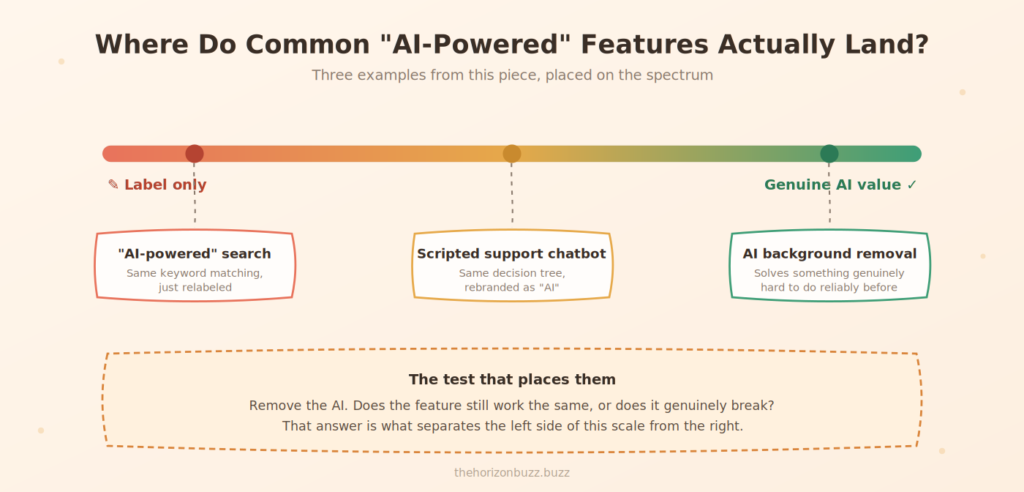
The simplest way to evaluate any “AI-powered” feature is to ask one question: if you removed the AI, would the task actually get harder, slower, or worse or would nothing really change?
That single question filters out most of the noise. A few worked comparisons make it concrete:
Example 1: “AI-Powered” Search Bar
Some products now market their basic search function as “AI-powered search,” when what’s actually running is the same keyword-matching search that’s existed for two decades, occasionally with a thin layer of synonym-matching added. Remove the “AI” label and the feature works identically. This is AI-in-name-only — a marketing decision, not a product decision.
Contrast that with genuine AI-assisted search: a tool that lets you type “the email where someone complained about pricing last month” and actually finds it, because it understands intent and context rather than requiring exact keyword matches. Remove the AI here, and the feature genuinely stops working you’re back to manually scrolling or guessing the right keywords.
Example 2: “AI-Powered” Photo Filters
A filter that applies a preset color adjustment doesn’t need AI — it’s a fixed transformation, the same one that’s existed in photo apps for years, now just relabeled. Compare that to AI-powered background removal, which has to actually understand where a subject ends and a background begins across wildly different photos. That’s a task that was genuinely hard to do well before machine learning made it reliable this one earns the label.
Example 3: “AI-Powered” Customer Support
A chatbot that follows a rigid decision tree (“press 1 for billing”) relabeled as “AI-powered” is the same interaction people have been frustrated with for fifteen years, just with different marketing copy. A chatbot that can actually read a customer’s specific, oddly-worded complaint and route it correctly, or resolve it directly by understanding context from their account history, is doing something a fixed script structurally cannot.
Why This Happens: The Incentive Problem
It’s worth understanding why this pattern is so common, rather than assuming it’s simple dishonesty. A few forces push products toward the label regardless of substance:
- Investor and buyer pressure. “AI-powered” performs well in pitch decks and marketing copy, creating pressure to use the term even when the underlying feature is minor.
- Genuine AI integration is expensive and hard to get right. Building AI that reliably improves a task takes real engineering and testing time; slapping a label on an existing feature takes an afternoon.
- Users often can’t tell the difference from the outside. Without technical visibility into what’s actually running, “it says AI, so it must be AI” becomes the default assumption which is exactly the gap this kind of skepticism closes.
This isn’t just a consumer annoyance it’s gotten companies sued. In 2024, the FTC went after a company marketing its product as “the world’s first robot lawyer,” despite never actually testing whether the software could do what it claimed. In early 2025, the SEC brought its first case against a public company for “AI washing” a restaurant-tech company accused of dramatically overstating what its voice AI could actually do at the drive-thru.
The pattern in these cases is the same one this article keeps coming back to: the gap between what “AI-powered” claims and what actually runs under the hood. When that gap gets wide enough, it stops being a marketing quirk and starts being a legal problem.
That doesn’t mean every company slapping “AI” on a feature is lying. Often it’s a small team genuinely convinced their AI layer matters more than it does. But the fact that this pattern is common enough to draw federal lawsuits is a useful reality check: skepticism toward “AI-powered” claims isn’t cynicism, it’s just paying attention.
A 5-Question Checklist for Evaluating Any “AI-Powered” Feature
Next time you see the label on a product you’re considering buying, a tool you’re evaluating for work, or a feature update in software you already use run it through these:
- What specifically does the AI do here, in one sentence? If you can’t get a clear answer from the product’s own marketing, that’s often itself a signal.
- Could this be done with a simple rule or fixed logic instead? If a basic if/then rule would produce the same result, the AI likely isn’t doing meaningful work.
- Does it get noticeably better with more use, or does it behave identically every time? Genuine machine learning features often improve or personalize over time; static “AI” features usually don’t.
- Would removing the label change how the feature actually performs? This is the core test from earlier, applied directly.
- Is the AI solving a problem that was previously hard, or convenient? “Hard” problems (understanding unstructured text, recognizing images, generating something genuinely tailored) are strong AI use cases. “Convenient” problems (adding a chat interface to something that already worked fine as a form) often aren’t.
If a feature fails most of these, it’s likely AI-labeled rather than AI-driven which doesn’t necessarily make it bad, but it does mean you shouldn’t pay a premium for the “AI” part specifically, or expect it to outperform the non-AI version.
What This Means If You’re Building, Not Just Buying
For builders and small teams, this cuts the other way too: it’s worth resisting the temptation to add “AI-powered” to a feature just because it’s trendy. A well-built, honest feature that doesn’t use AI at all but genuinely solves the user’s problem will outperform a poorly-integrated AI feature that technically qualifies for the label but adds friction, cost, or unpredictability.
The products earning genuine trust in this environment tend to do one of two things: either they use AI conservatively and explain clearly what it does, or they skip the label entirely and let the feature’s usefulness speak for itself.
FAQ
Is all “AI-powered” marketing misleading?
Not all of it some products genuinely use AI to solve problems that were previously difficult, and label it accurately. The issue is that the term has become common enough to be applied loosely, which means it can’t be trusted as a signal on its own anymore. Evaluate the specific feature, not the label.
How can I tell if a chatbot is actually using AI or just following a script?
Ask it something slightly outside its expected script a rephrased question, a typo, or an unusual combination of requests. A rule-based system will often fail to understand or default to a generic response, while a genuinely AI-driven one will typically still follow the intent.
Does “AI-powered” always mean a large language model is involved?
No “AI” is a broad category that includes machine learning models for things like image recognition, recommendation systems, and pattern detection, not just large language models like the ones behind chatbots. The label alone doesn’t tell you which kind of AI, if any, is actually running.
The Real Takeaway
The label “AI-powered” tells you almost nothing on its own anymore it’s become a marketing default rather than a technical claim. The actual question worth asking, every time, is the one at the center of this piece: does removing the AI change whether the feature works? That single test cuts through most of the noise, and it’s a habit worth building whether you’re choosing tools, evaluating a purchase, or deciding what to actually build next.
Related Buzz: We also covered [AI Governance for Small Businesses]