
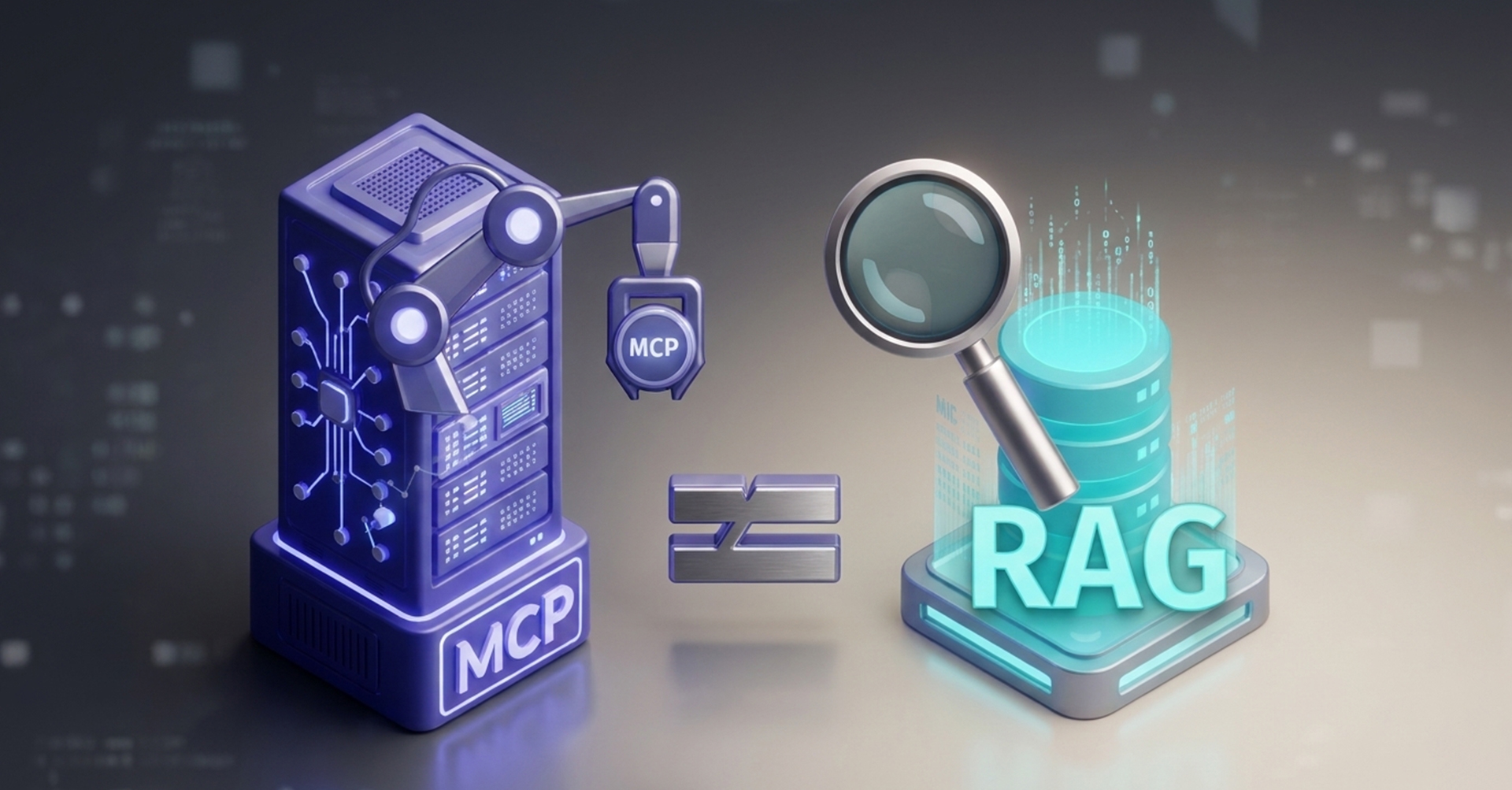
As AI agents become more capable, one question keeps coming up: Should your agent use RAG or MCP?
The short answer is both.
Despite being discussed as competing approaches, RAG (Retrieval-Augmented Generation) and MCP (Model Context Protocol) solve entirely different problems. One helps AI search large collections of information quickly, while the other allows it to retrieve live data and interact with real-world systems.
The real challenge isn’t choosing one over the other—it’s knowing which type of data belongs in each layer. Product documentation, internal policies, and knowledge bases benefit from indexing with RAG. Customer records, inventory levels, support tickets, and calendars are better fetched in real time using MCP.
If you’re building AI assistants, customer support bots, enterprise copilots, or autonomous AI agents, understanding where each technology fits will help you build faster, smarter, and more reliable systems.
TL;DR
- RAG helps AI agents search pre-indexed knowledge like documentation, policies, and internal wikis.
- MCP enables AI agents to fetch live data, interact with APIs, and perform real-time actions.
- Use RAG for large, stable, read-only datasets and MCP for dynamic information and write operations.
- Most production AI agents combine RAG and MCP to balance speed, accuracy, and real-time functionality.
- Choosing the right approach depends on your data, use case, and how your AI agent interacts with external systems.
What Is RAG?
Retrieval-Augmented Generation (RAG) gives AI models access to information that wasn’t part of their original training data.
Instead of asking the language model to answer everything from memory, RAG searches a pre-built knowledge base, retrieves the most relevant pieces of information, and includes them in the prompt before the model generates its response.
The process begins long before a user asks a question. Documents from sources like Notion, Google Drive, SharePoint, PDFs, or internal wikis are collected, cleaned, broken into smaller chunks, converted into embeddings, and stored inside a vector database. When a question arrives, the system searches those embeddings to find the most relevant content in milliseconds.
This approach makes RAG especially effective for large collections of documentation where semantic understanding matters more than exact keyword matching.
What Is MCP?
Model Context Protocol (MCP) takes a completely different approach.
Rather than searching information that’s already been indexed, MCP allows AI agents to communicate directly with external tools, APIs, databases, and business applications during runtime.
Whenever the AI needs current information, it simply requests it from the source.
If it needs to update a CRM, create a support ticket, book a meeting, or send an email, MCP enables those actions as well.
In other words, RAG helps an AI answer questions better, while MCP enables it to actually do the work.
The Biggest Difference Between RAG and MCP
The easiest way to think about these technologies is by comparing them to how people work. Imagine an employee answering customer questions.
If they consult the company handbook before responding, they’re using something similar to RAG.
If they log into Salesforce, Jira, or a banking application to check the latest information before answering, they’re behaving more like MCP.
One searches knowledge. The other interacts with live systems. Modern AI agents need both.
When RAG Is the Better Choice
RAG performs best when information is relatively stable and doesn’t change every few minutes.
Company documentation, training manuals, technical guides, help center articles, compliance policies, historical support tickets, and research papers are all excellent candidates for indexing.
Since embeddings are generated only once, searching becomes incredibly fast and inexpensive. Even millions of documents can be searched within milliseconds while maintaining strong semantic accuracy.
For knowledge-heavy applications, RAG remains one of the most cost-effective approaches available.
When MCP Makes More Sense
Some information simply can’t be indexed ahead of time.
Customer account balances, inventory levels, order status, sales pipelines, calendar availability, support tickets, and stock prices are constantly changing. Embedding this information every few minutes would be expensive, inefficient, and still leave the AI working with stale data.
MCP avoids this entirely by retrieving information directly from the source whenever it’s needed.
Even more importantly, MCP allows AI agents to perform actions instead of simply reading information.
An AI can update records, submit forms, send notifications, or complete workflows without requiring human intervention.
Why Most Production AI Agents Use Both
The best AI systems don’t force a choice between RAG and MCP they combine them. Consider a customer requesting a refund.
The AI first retrieves the company’s refund policy using RAG. Next, it checks the customer’s latest order through MCP. If the refund is valid, it processes the refund using another MCP tool and finally creates a support ticket documenting what happened.
Each technology handles the type of information it’s best suited for. This hybrid architecture is becoming the standard for enterprise AI.
Search Quality vs Real-Time Accuracy
One of the biggest strengths of RAG is semantic search. Instead of looking for exact keywords, it understands meaning.
A search like: “Customers affected by last week’s payment issue”
can retrieve information across support tickets, release notes, documentation, and Slack conversations, even if those exact words never appear together.
Traditional API search through MCP is limited by whatever filters the underlying application provides. However, MCP always has one major advantage: the information is current. If a CRM record changed five seconds ago, MCP sees it immediately. RAG only knows what has already been indexed.
Security and Permissions
Permissions are another major consideration.
With RAG, developers typically manage access by attaching permission metadata to every indexed document. This works well but requires constant synchronization as permissions change.
MCP takes a different approach.
Since every request goes directly to the source application, access is controlled using the same authentication and authorization mechanisms the business already trusts.
For organizations with strict compliance requirements, this significantly reduces the risk of exposing outdated or unauthorized information.
Building AI Agents That Scale
As AI systems become more autonomous, they’ll need to combine documentation, business data, APIs, workflows, and multiple software platforms into a single conversation.
That means the future isn’t about replacing RAG with MCP—or vice versa.
It’s about deciding which information should be indexed for fast retrieval and which information should always remain live.
Getting that architecture right is often the difference between an AI assistant that merely answers questions and one that actually helps people get work done.
The Best of Both Worlds
RAG and MCP aren’t competing technologies they’re complementary building blocks for modern AI agents.
RAG excels at searching large knowledge bases quickly and cost-effectively, while MCP provides access to live business data and enables AI to interact with real-world systems. Together, they allow AI agents to answer questions accurately, retrieve up-to-date information, and automate meaningful tasks.
If you’re designing AI applications in 2026, the smartest approach isn’t choosing between RAG and MCP it’s knowing when each one belongs in your architecture.
Related Buzz: We also covered [Why Multi-Agent Systems Are Becoming the Backbone of Enterprise AI]