
Your Next Coworker Isn’t Human ; It’s an Agent
AI NOW

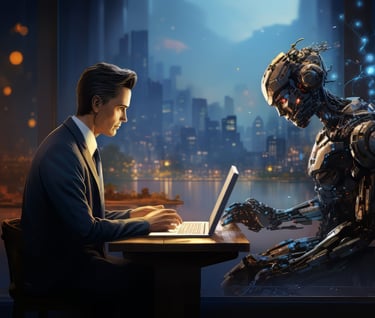
Work is undergoing a quiet but fundamental transformation.
For decades, the structure of work has remained largely the same. People used tools to complete tasks, collaborated with other people, and relied on systems that required constant human input. Software supported work, but it never truly participated in it.
That dynamic is changing. We are entering an era where the next coworker you collaborate with may not be human at all.
It will be an AI agent, a system capable of understanding goals, making decisions, and executing tasks with minimal supervision.
TL;DR
Your next coworker won’t be human. It will be an agent.
AI is evolving from a tool into a teammate capable of executing tasks, making decisions, and running workflows. The future of work isn’t about doing everything yourself.
It’s about designing systems that do it with you.
From Tools to Teammates
Traditional software has always been reactive. You provide instructions, and it responds. The relationship is linear and predictable.
Agentic AI breaks that model. Instead of waiting for step-by-step commands, AI agents operate with a degree of autonomy. You define an objective, and the system determines how to achieve it. It can break down complex tasks, prioritize actions, and execute workflows across multiple tools and platforms. This shift turns software from a passive tool into an active participant.
It is no longer something you use. It becomes something you work with.
Redefining How Work Gets Done
As agents take on more responsibility, the nature of work itself begins to change. Tasks that once required direct human involvement, such as writing reports, analyzing data, managing schedules, and responding to routine communication, can now be handled by intelligent systems. These agents operate continuously, adapt to feedback, and improve over time.
The role of the human shifts from execution to oversight. Instead of doing every task manually, individuals define goals, guide processes, and evaluate outcomes. Work becomes less about completing individual actions and more about managing systems that perform those actions.
The Rise of Orchestration
This evolution introduces a new layer to productivity: orchestration. Success is no longer determined solely by how well someone performs a task, but by how effectively they design and manage workflows that include AI agents.
Those who understand how to integrate agents into their processes can achieve significantly higher output with less effort. They can scale their work, reduce repetitive tasks, and focus on higher-level thinking. In this environment, efficiency is not just about speed. It is about leverage.
A New Skill Set Emerges
As the workplace evolves, so do the skills required to thrive within it. Technical expertise remains important, but it is no longer the only differentiator. The ability to think in systems —to break down problems, assign responsibilities, and coordinate between human and AI efforts-becomes increasingly valuable.
Understanding how agents behave, where they excel, and where human judgment is still necessary will define effectiveness in this new landscape.
The most successful individuals will not be those who do the most work, but those who design the best systems for getting work done.
The Invisible Workforce
One of the most significant aspects of this shift is how subtle it is. AI agents often operate behind the scenes. They assist with decision-making, automate processes, and generate outputs without drawing attention to themselves. This creates an invisible workforce — one that does not appear in organizational charts but contributes directly to productivity and growth.
Organizations that embrace this invisible layer will operate differently. They will move faster, adapt more quickly, and scale more efficiently than those that rely solely on human effort.
Balancing Control and Dependence
While the benefits are significant, this transformation also introduces new challenges.
Relying on AI agents means depending on systems that are not fully transparent or entirely under individual control. Decisions may be influenced by models and data sources that are not always visible.
This raises important questions about trust, accountability, and oversight. The goal is not to replace human involvement, but to find the right balance where agents enhance productivity without removing critical human judgment.
The Future of Work Is Hybrid
The workplace of the future will not be defined by humans or machines alone, but by a combination of both.
Teams will consist of people and agents working together, each contributing in different ways. Humans will provide context, creativity, and strategic thinking, while agents will handle execution, optimization, and scale.
This hybrid model has the potential to redefine productivity. It allows individuals and organizations to achieve more than either could alone.
Where business meets innovation, and trends turn into opportunities. Stay sharp, stay ahead, and catch the buzz that’s shaping the future.