
TL;DR
- AI agents in text messages work like a contact you text: your message goes to the company’s servers, an AI model works out what to do, and it uses your connected apps to do it. They’re worth trying for small, repeatable jobs, but most are too early to run your whole life.
- Unlike a chatbot, they act and remember. They can book, remind and follow up, and they can message you first.
- The audience is huge: WhatsApp alone has more than 3 billion monthly users.
- Platform owners decide where these agents can live. Meta barred general-purpose AI assistants from the WhatsApp Business API from January 15, 2026, and the EU ordered it to let them back in Europe.
- Trust is the big hurdle: 71% of people worry an AI agent could misrepresent their personality or values.
AI agents in text messages are AI assistants you save as a contact and text in iMessage, WhatsApp, SMS or Telegram, and they can take actions for you, not just answer questions. Behind the chat, an AI model reads your message and uses the apps you’ve connected, like your calendar and email, to get the job done. In our view they’re worth trying for one or two small tasks, but give them your whole inbox only once they’ve earned your trust.
Why the next AI app might not be an app
For three years, using AI has meant opening an app: ChatGPT, Gemini, Claude. A new group of startups is betting that’s backwards. Instead of you going to the AI, the AI should come to the one place you already check hundreds of times a day: your messages.
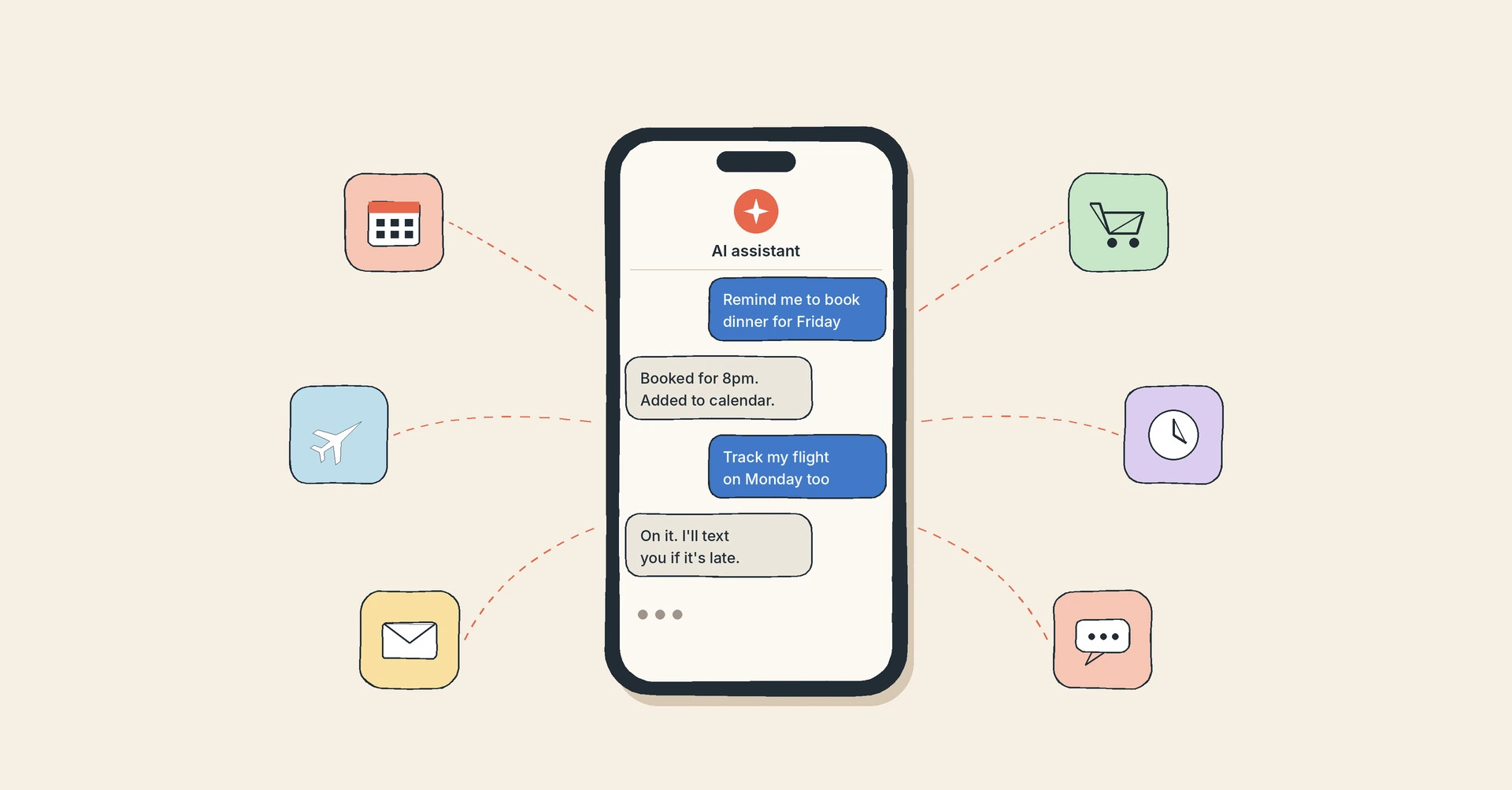
The pitch is simple. Text it like a friend. “Remind me to pay the electricity bill on the 5th.” “Find a birthday gift for my sister.” “What time is my flight on Monday?” It replies in the same thread, does the job and, if needed, messages you again later.
It sounds like a small change. It isn’t. Moving AI into your messages changes how it reaches you, what it can see and who controls whether it’s allowed to exist at all. Here’s how it works, and what we think of it.
The numbers behind the trend
| Stat | What it tells us |
|---|---|
| 3 billion+ people use WhatsApp every month (Nairametrics, reporting Meta’s Q1 2025 earnings, May 2025) | Messaging apps are where the users already are. |
| 1 billion+ active Telegram users (TechCrunch, March 2025) | Several texting agents already work there. |
| 64% of US adults now use AI (Menlo Ventures, 2026) | AI has gone mainstream, so the race is now about where people use it. |
| 41% of AI users have tried an AI agent, and 24% use one regularly (Menlo Ventures, 2026) | Agents that act, not just chat, are moving past early adopters. |
| 42% would let an AI agent spend up to $100 for them, while 22% wouldn’t let it handle money at all (Ping Identity via PR Newswire, October 2026) | People will hand over small jobs before big ones. |
| 20+ AI agents that live in text messages (TechCrunch, November 2026) | The category has gone from one or two experiments to a crowded field. |
| $1 billion raised by text-and-voice agent Instinct at a $10 billion valuation, a month after it was valued at $2.5 billion (TechCrunch, November 2026) | Investors are betting big on this category. |
| 40%+ of company “agentic AI” projects expected to be cancelled by the end of 2027 (Gartner, June 2025) | Plenty of “agents” won’t survive. |
| ~130 of the thousands of vendors selling “agentic AI” are the real thing, by Gartner’s estimate (Gartner, June 2025) | Many “agents” are rebranded chatbots, which Gartner calls “agent washing”. |
Put together, the picture is clear: the audience is huge and lots of people are ready to try AI agents, but most still want to keep a hand on the wheel.
How AI agents in text messages actually work
When you text one of these agents, your message goes on a short journey. Think of it as three layers.
Layer 1: The messaging channel
This is the pipe your message travels through. It might be SMS, iMessage, RCS (the upgraded texting standard on Android), WhatsApp or Telegram. For the agent, each of these is a different door with a different owner. Apple, Google, Meta and Telegram each decide which businesses can plug in and on what terms.
That’s why so many of these agents are iMessage-only or SMS-only: they started with the doors that were easiest to open. It’s also why their availability can change overnight, as we’ll see with WhatsApp below.
Layer 2: The AI brain
Once your message arrives on the company’s servers, an AI model reads it and works out what you want. Is it a question to answer, a reminder to set, or a task with several steps, like checking your calendar and then booking a table?
This is where the “agent” part comes in. A chatbot writes a reply. An agent plans a series of actions, carries them out and checks the result. It also keeps a memory of you: your preferences, your family’s names, what you asked for last week. That memory is what lets it say “Want me to book the same place as last time?”
Layer 3: The connections
An agent is only as useful as what it can reach. To add events, read emails or shop for you, it needs permission to connect to your Google or Outlook account, your calendar, your files, and sometimes your other chats. You usually grant this once, with a login screen.
Those connections are what turn a smart text into a finished job. They’re also where most of the risk lives, because the agent can now read, and sometimes send, on your behalf.
The twist: it can text you first
Apps wait for you to open them. A text-based agent can tap you on the shoulder: a summary of tomorrow’s plans every evening, a reminder before a deadline, or a follow-up on something you asked days ago. That’s the feature that makes these agents feel like an assistant rather than a search box.
Some real examples
You don’t need to know every name, but a few examples show what’s out there today. All details are from TechCrunch’s roundup (TechCrunch, November 2026).
| Agent | What it’s built for | Where you text it |
|---|---|---|
| Poke | A general personal assistant | Text messages; the first AI agent on Apple Messages for Business |
| Folk | Memory, research, bookings | iMessage, WhatsApp, Telegram |
| Maverick | Everyday chores, and it asks before acting | iMessage |
| Fambot | Running a busy family’s schedule | SMS, app, web |
| Tomo | Helping a whole group chat | iMessage |
The gatekeepers: who decides where these agents can live
Here’s the part most coverage skips. These agents don’t own the roads they drive on.
In October 2025, Meta changed the terms of the WhatsApp Business API, the official way companies connect to WhatsApp. From January 15, 2026, general-purpose AI assistants were barred when the assistant itself is the main product. Businesses could still use AI for their own customer service, but standalone assistants such as ChatGPT, Perplexity and Poke were affected, leaving Meta AI as the main assistant inside WhatsApp. Meta said the API was built to help businesses support customers and send updates (TechCrunch, October 2025).
Europe pushed back. The European Commission opened an antitrust investigation in December 2025, and on June 9, 2026, it ordered interim measures: Meta had to restore free access for rival AI assistants, on the same terms as before (EU Perspectives, June 2026). That order is about competition in Europe. Outside Europe the rules may be different, so check whether any WhatsApp-based agent actually works for you before you rely on it.
Apple plays gatekeeper too. Poke’s big moment in June 2026 was simply Apple approving it for Messages for Business (TechCrunch, November 2026). Which agents you can use, and where, is partly decided by a handful of platform companies, not just by the startups building them.
Our take: useful, but not ready to run your life
What’s genuinely good. Texting is the most natural interface there is. No new app, no learning curve, and it works for people who’d never open ChatGPT. For small, boring, repeatable jobs, like reminders, calendar entries from emails, and nightly family summaries, a texting agent is a real upgrade.
What’s hype. Many of these products promise a full-time human-style assistant. Most are in beta, many only work on iPhone or with US numbers, and the hard part, doing multi-step tasks reliably without mistakes, is still hard for every AI company. Gartner’s warning about “agent washing” applies here too: not everything called an agent really is one (Gartner, June 2025). A wrong calendar entry is annoying. A wrong booking or a wrongly sent email is worse.
What worries us. These agents work best when they see everything: your inbox, calendar, files and chats. That’s a lot to hand to a young startup, some of which have already been bought by bigger companies. And because platform owners can change their rules, an agent you depend on could lose its WhatsApp or iMessage access with little warning.
Our advice. Pick one task, not your whole life. Choose an agent that asks before it acts. Connect only the accounts that task needs. If it still earns its place after a month, give it more.
FAQ
What are AI agents in text messages?
They’re AI assistants that live inside a messaging app instead of their own app. You text them in iMessage, WhatsApp, SMS or Telegram, and they can take actions such as setting reminders, adding calendar events or booking things.
How is a texting AI agent different from ChatGPT?
ChatGPT mainly answers when you ask. A texting agent is built to act: it connects to your other apps, carries out tasks, remembers your preferences and can message you first with reminders or updates.
Can AI agents work on WhatsApp?
It depends where you are. Meta barred general-purpose AI assistants from the WhatsApp Business API from January 15, 2026 (TechCrunch, October 2025). In June 2026 the European Commission ordered Meta to restore free access for rival assistants in Europe (EU Perspectives, June 2026). Outside Europe, check each agent’s current WhatsApp support.
Is it safe to let an AI agent read my messages and email?
It carries real risk. Only connect the accounts a task needs, prefer agents that ask before acting, read the privacy policy, and never share passwords or banking details in the chat.